Notes on AI systems, hybrid LLM architectures, specialization, and
operational control.
Note su sistemi AI, architetture LLM ibride, specializzazione e
controllo operativo. Gli articoli sono disponibili in inglese.
From RAG to high-risk system: what changes in the architecture when you add scoring
Published: 6th March 2026
You have a working RAG pipeline. You add a scoring function. Architecturally, it looks trivial — one more field in the database, one more LLM call. But this single change shifts the system into the EU AI Act's high-risk category, and that has direct consequences for the architecture you need to build. This article shows exactly what changes, with code.
The original RAG pipeline — baseline architecture
The system I built for Founder Institute Philadelphia was a standard RAG pipeline. A founder visits the application page, starts a conversation, and the chatbot answers questions about the program — structure, requirements, what FI looks for.
The execution path is straightforward:
Retrieval: the user query is embedded and matched against a vector store of FI documentation
Prompt construction: retrieved chunks are injected into a system prompt alongside the conversation history
LLM call: the assembled prompt is sent to the model
Response: the answer is streamed back to the user
No persistence beyond the session. No output that influences decisions about any specific person. The system produces text; what a human does with that text is entirely outside the system boundary.
Under the EU AI Act, this is a limited-risk system. The only obligation is transparency: the user must know they are interacting with an AI. The full implementation is available at github.com/gianlucacapuzzi/slearnt.
Adding scoring — three lines that change everything
Now imagine adding one feature: a Founder Score. While the founder chats, the system analyses their responses and assigns a score from 1 to 10 based on "startup readiness." That score is saved to the CRM and used by program directors to decide who to invite to interviews.
The delta in the codebase is small. Something like this:
async def score_founder(conversation_history: list[dict]) -> dict:
    prompt = build_scoring_prompt(conversation_history)
    response = await llm.complete(prompt)
    score = extract_score(response.text)

    # Persisted to CRM — this is the line that changes everything
    await crm.upsert_founder_score(
        founder_id=session.founder_id,
        score=score["value"],
        rationale=score["rationale"],
        timestamp=datetime.utcnow()
    )
    return score
Three things happened here that did not happen before. The output is persisted beyond the session. It is attributed to a specific person. And it is used as input to a human decision — whether to invite this founder to an interview.
This is the operational definition of high-risk under Annex III of the EU AI Act, point 4(a): systems used for recruitment or selection of natural persons. The AI Act does not care about model architecture. It cares about what the system's output does to people.
The three architectural components required for high-risk systems
1. Logging and audit trail
For a limited-risk system, logging is optional and driven by operational needs. For a high-risk system, it is a legal requirement. The log must be sufficient to reconstruct the basis for any decision and demonstrate that the system operated within its intended parameters.
In practice, every scoring event needs a structured record:
The human_reviewed, human_reviewer_id, override_value, and override_rationale fields are not cosmetic. They are the audit trail for human oversight — which brings us to the next component.
2. Human oversight interface
The AI Act requires that high-risk systems be designed so that humans can effectively oversee, understand, and intervene in their operation. "A human in the loop" is not sufficient if that human cannot realistically exercise judgment. The interface must make the AI's reasoning legible and the override path frictionless.
In the Slearnt implementation, this means the program director sees not just the score but the rationale, the specific conversation turns that drove the score, and a one-click override with a required free-text explanation. The override is written back to the log and propagates to downstream systems.
The key design principle: an override should take less effort than accepting the AI's recommendation. If the interface makes overriding harder than accepting, you have not implemented human oversight — you have implemented rubber-stamping.
3. Bias mitigation and technical documentation
The AI Act requires technical documentation that describes the system, its intended purpose, performance metrics, and known limitations. This is often framed as a compliance exercise — a document you produce to satisfy an auditor. That framing misses the point.
The documentation requirement forces you to answer questions that you should be answering anyway: What population of founders was represented in the prompts used to design the scoring rubric? What correlates with a high score? Are those correlates legitimate proxies for startup readiness, or are they proxies for demographic characteristics?
For an LLM-based scoring system, bias mitigation is not primarily a model problem — the base model's biases are largely outside your control. It is a prompt and rubric design problem. The scoring criteria need to be explicit, the rubric needs to be tested against diverse conversation samples, and the distribution of scores across different founder profiles needs to be monitored in production.
What does not change — and why this matters
The underlying LLM does not change. The retrieval mechanism does not change. The conversation handling does not change. Adding scoring did not require replacing any component of the original architecture.
This is an important point for how you think about compliance. The AI Act does not regulate models. It regulates the use of model outputs to make decisions about people. A model that generates text is unregulated. The same model, whose output is persisted and used to filter job candidates, is high-risk.
The implication for architecture: compliance work is additive, not transformative. You are adding a logging layer, an oversight interface, and a documentation process on top of a system that continues to function as before. The base RAG pipeline does not need to be redesigned.
Implications for teams building similar systems
The pattern generalises. Any system that produces outputs used to evaluate people — ATS scoring, credit assessment, clinical triage support, student evaluation — faces the same architectural requirements.
The practical recommendation is to treat high-risk classification as a design input, not a post-hoc compliance problem. Before writing the first line of code for a scoring or evaluation feature, answer three questions:
Will this output be persisted and attributed to a specific person?
Will a human use this output to make a consequential decision about that person?
Does this use case fall within Annex III of the EU AI Act?
If the answer to all three is yes, the logging schema, oversight interface, and documentation need to be designed from the start — not retrofitted after the feature ships.
Retrofitting is always more expensive. In production systems with existing data, existing users, and existing integrations, adding a compliance layer after the fact typically means schema migrations, interface redesigns, and months of engineering time that could have been avoided.
The compliance perspective on this case study — obligations, deadlines, and what this means for deployers and providers — is covered in detail at euaiact.pro. The full implementation, including the logging schema and oversight interface, is at github.com/gianlucacapuzzi/slearnt.
Gianluca Capuzzi — PhD, AI Systems Engineer. I work on hybrid LLM architectures, operational control, and failure transparency in production AI systems. EU AI Act compliance consulting for SMEs at euaiact.pro.
August 2026 is coming and many Italian companies don't yet know they're affected by the EU AI Act.
I created euaiact.pro to help them: practical guides,
downloadable checklists and consulting for companies using AI in finance, healthcare and HR.
Why agentic architectures fail economically and how hybrid SLMs change
the cost curve
Published: 10th February 2026
The most expensive part of an LLM system is not inference.
In production environments, the dominant cost of large language model
systems is rarely the price of tokens. Instead, it is the
human time
spent designing, monitoring, debugging, and explaining systems whose
behavior becomes increasingly opaque as complexity grows.
Over the past year, agentic architectures (often built on top of
Retrieval-Augmented Generation) have been proposed as a way to improve
reasoning, autonomy, and task completion. In controlled demos, these
systems can appear remarkably powerful. In production, however, their
operational cost profile is frequently underestimated.
Each additional reasoning step introduces not only more inference
calls, but also a wider surface for failure, higher latency, and a
growing need for human intervention. This creates a fundamental
mismatch:
reasoning capability scales faster than operational
controllability.
In this article, I examine this mismatch through a concrete experiment
comparing a fully agentic RAG pipeline with a hybrid architecture
based on fine-tuned Small Language Models (SLMs) and lightweight
routing. Rather than optimizing for benchmark performance, the focus
is on how different design choices affect
cost curves, debuggability, and incident response in
production-like settings.
The key insight is not that smaller models are "cheaper". It is that
specialization changes the economics of reasoning systems,
shifting cost away from unbounded inference and back toward
predictable, controllable components.
The hidden cost of reasoning systems.
The primary cost driver of modern LLM systems is not model size, context length, or token pricing. It is the cost of control.
As reasoning pipelines become more complex (adding planners, tools, memory layers, and retries) the system's behavior becomes harder to predict and harder to explain.
Each additional component introduces new failure modes, longer execution paths, and more opportunities for silent degradation.
The result is not just higher inference cost, but a growing burden on the humans responsible for keeping the system reliable.
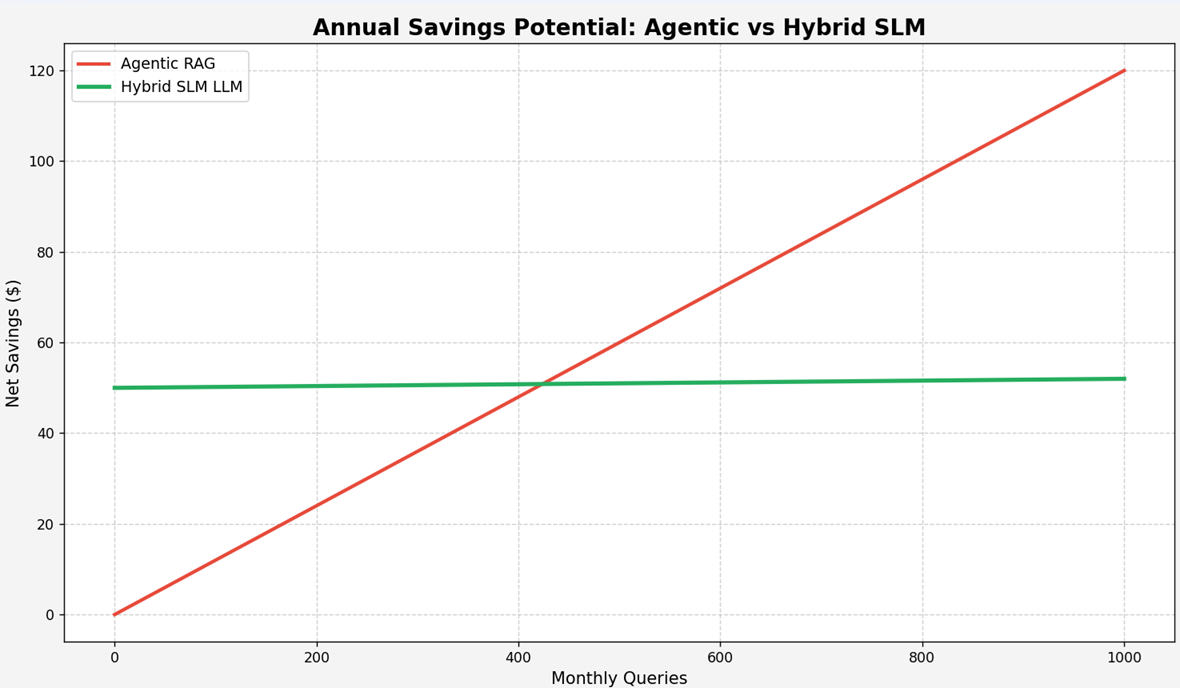
The figure below illustrates this effect.
While inference-heavy architectures such as agentic RAG scale linearly in terms of token usage, their total operational cost grows superlinearly once human
intervention is taken into account. Debugging multi-step reasoning chains, inspecting partial traces, and performing root cause analysis after incidents quickly
dominate the cost profile.
Total operational cost grows superlinearly for agentic RAG once human
intervention is included, while hybrid SLM architectures maintain a
predictable cost curve.
What is often missed in architectural discussions is that time does not scale like compute.
A failed request that triggers multiple retries, partial tool executions, or inconsistent intermediate states can consume hours of engineering effort,
even if the direct inference cost remains low. As system load increases, these rare failures stop being rare.
This is why many agentic systems appear economical in early prototypes but become increasingly expensive in production.
Their cost curves are shaped less by tokens and more by operational entropy: the accumulation of complexity that erodes observability, predictability, and control.
Understanding this hidden cost is essential before comparing architectures. Without accounting for the human effort required to operate and debug reasoning systems,
any cost analysis remains incomplete.
Why Agentic RAG scales poorly
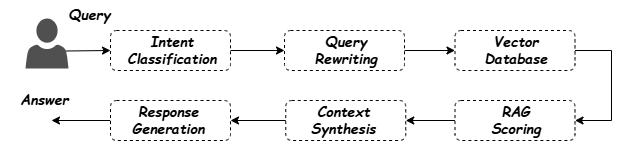
To understand why agentic architectures scale poorly in production, it is useful to examine a single query traced end-to-end through an agentic RAG pipeline.
The experiment analyzed here consists of a factual query executed against an agentic RAG system with intent detection, query rewriting, multi-stage retrieval, external source validation,
synthesis, and post-hoc quality checks. While each component is individually reasonable, their composition reveals a different picture.
The agentic loop workflow shows how a single query can trigger multiple internal steps, each with their own failure modes and debugging complexity.
For a single user query, the system executed 12 LLM calls, resulting in:
~ 5700 input tokens
~ 2000 output tokens
0.12$ in inference cost
At first glance, these numbers may appear acceptable. The response quality score was high, and the final answer was grounded in authoritative sources.
However, these metrics obscure the structural problem.
Each LLM call represents a branching point in the execution graph. Intent classification, query rewriting, retrieval scoring, synthesis, validation,
and hallucination checks all introduce states that must be coordinated, logged, and interpreted when something goes wrong.
When a failure occurs, the question is no longer "did the model answer correctly?" but "which step failed, and why?"
The trace makes this explicit. A single request produces multiple intermediate artifacts (rewritten queries, ranked document chunks, synthesized contexts, validation reports)
each with its own assumptions and potential inconsistencies. While this structure improves answer quality in isolation, it significantly increases the debug surface area of the system.
More importantly, these costs scale with reasoning depth, not with request volume. As traffic increases, even low-probability failures accumulate, and human intervention becomes unavoidable.
Root cause analysis in such systems often requires reconstructing execution paths across multiple model calls, external dependencies, and heuristic thresholds.
This is the core scaling failure of agentic RAG: reasoning steps multiply faster than observability and control mechanisms.
In practice, this means that adding more reasoning to improve quality can paradoxically reduce system reliability and increase operational cost.
The system does not fail catastrophically; it fails expensively, by demanding increasing amounts of expert attention to maintain acceptable behavior.
Specialization changes the cost curve
The failure mode of agentic RAG systems is often framed as an implementation problem: better prompts, better tools, better orchestration. In practice, the issue is more fundamental.
These systems assume that general-purpose reasoning can be applied uniformly across all tasks without significantly affecting operational cost.
Specialization breaks this assumption.
By delegating well-scoped, high-frequency tasks to fine-tuned Small Language Models (SLMs), it becomes possible to decouple reasoning depth from system complexity.
Instead of invoking a large model for every decision, a lightweight routing layer determines whether a request can be handled by a specialized model or requires escalation to a
general-purpose LLM.
The impact of this shift is not limited to inference cost. Routing introduces a control surface: a deliberate point at which behavior can be inspected, constrained,
and reasoned about. In a hybrid architecture, most requests follow short, predictable execution paths. Only a minority traverse deeper reasoning chains.
This changes the cost curve in two important ways. First, the average number of LLM calls per request drops sharply, reducing both latency and exposure to cascading failures.
Second, failures become easier to localize. When a specialized model produces an incorrect response, the error surface is smaller,
and root cause analysis does not require reconstructing multi-step reasoning graphs.
Crucially, this approach does not aim to replace large models. Instead, it repositions them as exceptions, not defaults.
General-purpose reasoning is reserved for genuinely ambiguous or novel queries, while specialized models handle the stable core of the workload.
From an operational perspective, this leads to a qualitatively different system behavior.
Cost grows more predictably with load, incident analysis becomes tractable, and human intervention shifts from continuous supervision to targeted escalation.
Specialization, in this context, is not an optimization. It is a structural change that restores controllability to reasoning systems.
A hybrid experiment
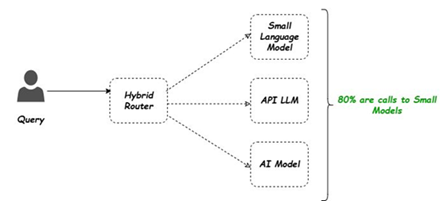
To evaluate the impact of specialization on system behavior, I implemented a hybrid architecture combining a fine-tuned Small Language Model (SLM) with a general-purpose LLM,
connected through a lightweight routing layer.
The hybrid architecture workflow shows how a single query can be routed to a specialized model or escalated to a general-purpose LLM.
The goal was not to optimize for absolute answer quality, but to observe how different architectural choices affect cost, latency, and operational complexity under realistic usage patterns.
The SLM was fine-tuned on a narrow, domain-specific corpus and deployed locally. Queries falling within this domain were handled entirely by the specialized model,
while broader or ambiguous requests were routed to a remote LLM. Both paths were instrumented to collect execution traces, latency, token usage, and failure signals.
Compared to the fully agentic RAG pipeline described earlier, the hybrid system exhibited a markedly different execution profile. Most queries completed in a single model call,
with no intermediate reasoning steps or post-hoc validation. As a result, average latency dropped significantly, and inference costs remained stable as load increased.
More importantly, the operational characteristics changed. Failures were easier to isolate,
and debugging typically involved inspecting a single model response rather than reconstructing a multi-stage reasoning graph.
In practice, this reduced the time required for root cause analysis and eliminated entire classes of cascading errors observed in the agentic setup.
It is worth emphasizing what this experiment does not claim. The hybrid approach does not outperform agentic RAG in all scenarios, nor does it eliminate the need for large models.
Instead, it demonstrates that introducing specialization and routing can fundamentally alter the cost structure of reasoning systems, trading maximal flexibility for predictability and control.
The experiment suggests that, for many production workloads, this trade-off is not only acceptable but desirable.
What this means for production teams
For production teams, the primary challenge of LLM systems is not model capability but operational sustainability.
Architectures that maximize reasoning flexibility often do so at the expense of predictability, making them difficult to operate with limited time, budget, and expertise.
The results above suggest a different framing. Instead of asking "how much reasoning can we add?", teams should ask "how much reasoning can we afford to control?"
Hybrid architectures shift this balance. By handling the majority of requests through specialized, bounded models, teams can reduce the cognitive load required to operate the system.
Monitoring becomes simpler, incident response faster, and failure modes more legible.
This is particularly relevant for small and medium-sized teams, where a single production incident can consume days of engineering time.
From a cost perspective, the benefits extend beyond reduced token usage. Fewer model calls mean fewer logs to inspect,
fewer thresholds to tune, and fewer opaque interactions between components. Over time,
this translates into lower maintenance cost and less dependence on a small number of domain experts who "understand how the system really works."
Perhaps most importantly, specialization enables intentional escalation. When a request is routed to a large model, it is a conscious decision rather than an implicit default.
This makes reasoning expensive by design, encouraging teams to reserve it for cases where its value is clear.
In practice, this approach supports a more mature production posture. Systems evolve incrementally, failures are contained,
and improvements can be measured against operational metrics rather than benchmark scores alone.
For teams deploying LLMs in real environments, the question is not whether agentic systems are powerful. It is whether their power aligns with the team's capacity to operate them.
Limits and failure modes
The hybrid approach described in this article is not a universal solution. Its advantages depend on task stability, domain boundaries, and the availability of
meaningful supervision signals. In environments where queries are highly diverse or poorly defined, specialization may introduce brittleness rather than control.
Fine-tuned SLMs are also sensitive to distribution shifts. When the input space drifts beyond the training domain, failures can be subtle and harder to detect than
in general-purpose models. Without explicit routing confidence thresholds or fallback mechanisms, incorrect specialization can degrade system performance silently.
There are also organizational limits. Designing and maintaining specialized models requires upfront effort: data curation, evaluation, and periodic retraining.
Teams without the capacity to invest in these activities may find that the promised operational gains do not materialize.
Finally, hybrid systems do not eliminate complexity—they redistribute it. While reasoning depth is reduced at runtime, architectural decisions move earlier in the lifecycle.
This shifts effort from reactive debugging to proactive design, which may not align with all team cultures or incentives.
These limitations are not arguments against specialization, but reminders that architectural choices encode trade-offs.
The goal is not to minimize reasoning, but to make its cost visible, bounded, and intentional.
In that sense, hybrid architectures do not simplify LLM systems. They make them operable.
Evaluation methodology
Routing behavior and response quality were evaluated using a combination of manual task-specific assessment and automated checks.
The focus was on correctness and operational behavior rather than benchmark optimization.
Google Colab links
Here two Colab notebooks are provided to reproduce the experiment: